

Complete Dentures vs. Partial Dentures: Which Option Fits Your Smile

If you're facing tooth loss, you've probably already heard the word "dentures" more than once — but not all dentures are the same. Complete dentures and partial dentures solve different problems, and choosing between them comes down to how many natural teeth you still have and how they're holding up. At Equinox Dental in Monroe, NC, we help patients throughout Union County and South Mecklenburg County figure out which option restores their bite, their confidence, and their comfort most effectively. Here's how the two compare.
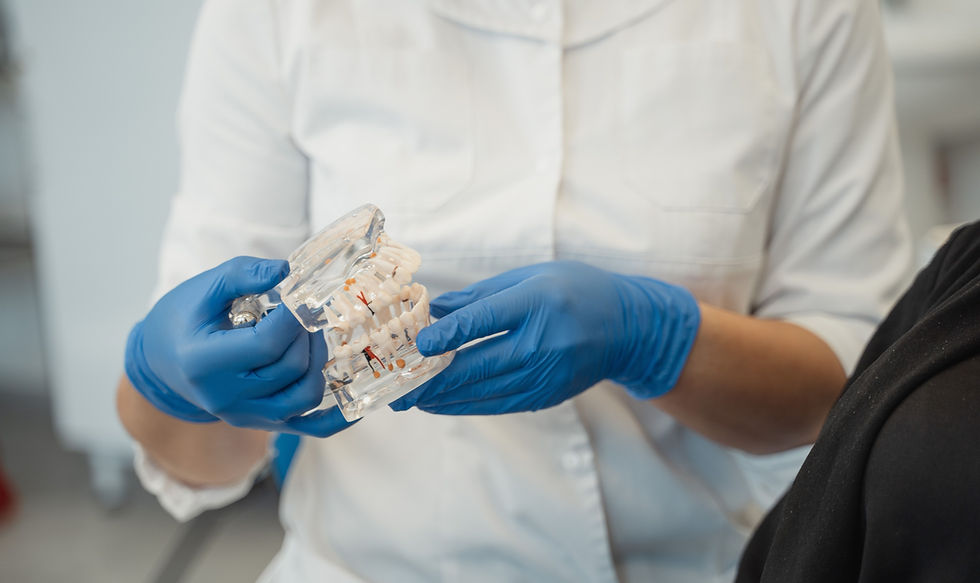
What's the Difference Between Complete and Partial Dentures?
Complete dentures replace an entire arch of teeth — either the top, the bottom, or both — after all natural teeth in that arch are gone. They rest directly on your gums and jawbone, held in place by suction, natural muscle control, and, in some cases, a denture adhesive.
Partial dentures are built for a different situation: you still have some healthy natural teeth, and you only need to replace the ones that are missing. A partial denture is designed with clasps or precision attachments that anchor to your remaining teeth, filling the gaps without disturbing what's still working well in your mouth.
The core question isn't which appliance is "better" — it's which one matches the state of your smile right now. If you have no teeth left in an arch, a partial isn't an option. If you still have several strong, healthy teeth, removing them just to qualify for a complete denture is rarely the right call.
When Complete Dentures Make Sense
Complete dentures are the right choice when an arch has no remaining teeth, or when the teeth that are left are too compromised by decay, infection, or bone loss to save. This is common after years of untreated dental disease, significant trauma, or advanced gum disease that has destroyed the bone supporting the teeth.
Because a complete denture relies on your gum ridge and jawbone for support, the fit depends heavily on how much bone is still present. During your exam, we'll evaluate your bone structure to determine whether a conventional denture will seat well, or whether an implant-supported option would give you significantly better stability — something we discuss openly with every denture patient rather than assuming one path fits everyone.
When Partial Dentures Make Sense
Partial dentures are the better fit when you still have healthy teeth in the arch. Rather than losing those teeth, a partial denture works with them, using them as anchor points to hold the replacement teeth securely in the gaps.
This matters for more than convenience. Your remaining natural teeth help preserve jawbone density in that area, keep your bite properly aligned, and give the partial denture a more stable, predictable fit than an appliance relying on gum tissue alone. Partials also prevent a problem many patients don't anticipate: neighboring teeth slowly drifting into an empty space, which can throw off your entire bite over time.
Comfort, Care, and Getting Used to Your New Dentures
Both complete and partial dentures require an adjustment period. It's normal to notice increased saliva production, minor speech changes, or mild soreness during the first couple of weeks as your mouth and muscles adapt. Eating starts easier with soft foods cut into small pieces, gradually working back toward your normal diet as you gain confidence.
Daily care is straightforward for either type: remove and rinse after meals, brush gently with a denture-specific cleaner (not regular toothpaste, which can be too abrasive), and soak overnight in a proper denture solution. Your gums and jawbone will continue to change shape over months and years, so periodic relines or adjustments are a normal part of ownership — not a sign anything went wrong with the original fit.
How Equinox Dental Helps You Choose the Right Fit
Because we provide extractions, bone grafting, implant placement, and both complete and partial dentures under one roof, you don't need to bounce between separate specialists to get a full picture of your options. We start with a thorough exam and imaging to assess your remaining teeth and bone, then walk you through exactly what each path involves — including whether an implant-retained denture could offer more security than a conventional one, if that's something you want to explore.
If tooth loss has you weighing your options, you don't have to figure it out alone. Call Equinox Dental at 980-290-7016 or visit equinoxdentalnc.com to schedule a consultation, and we'll help you find the denture solution that fits your mouth, your lifestyle, and your budget.


Comments